top of page
A true celebration of the BR High Speed Train fleet, covering the period between 2016 and early 2026.
.png)


At the start of 2016, 194 of the 197 BR-built Class 43s were still in action, hauling high-speed services across the UK, with the fleet split between CrossCountry, Grand Central, Great Western Railway, Midland Mainline, Network Rail and Virgin Trains East Coast.
However, with new high-speed fleets under construction and the HSTs having been in service on the UK rail network since late 1976, as 2026 arrived the fortunes of the Class 43s and Mk. 3 trailer coaches were vastly different to how they had been just 10 years earlier.
By 2026, there are no HSTs in daily timetabled passenger service in England, while short-formed HSTs continue in service on inter-city services in Scotland with - making the ScotRail Inter7City HSTs the only timetabled passenger trains to still be worked by HSTs.
First to go during the fifth decade was the small fleet of Grand Central HSTs, which operated open access services on the East Coast Main Line between Sunderland and London King's Cross. The three trains were cascaded to East Midlands Trains following their withdrawal by Grand Central on 31 December 2017.
Great Western Railway withdrew its long-distance HSTs in May 2019 following the introduction of a new fleet of Hitachi trains, with the operator retaining a small fleet of short-formed HSTs for working regional services in and around Devon and Cornwall - something which continued until December 2025 courtesy of the four-coach Castle Class HST sets. The Western Region of British Rail had been the first to introduce HSTs onto its services in 1976, so the Class 43s were a constant in the West of England for more than 49 years.
During 2019, a pair of five-coach HSTs were loaned by Great Western Railway to open access operator Hull Trains (also part of FirstGroup) to cover for Class 180s that had been suffering from poor availability. The HSTs and Class 180s were replaced by a brand new fleet of Hitachi bi-mode trains from the end of 2019.
In December 2019, it was the turn of principal East Coast Main Line operator London North Eastern Railway - the successor organisation to Virgin Trains East Coast - to dispense with its HSTs. LNER had also purchased a new fleet of Hitachi electric and bi-mode trains as it modernised its passenger fleet. Many of the ex-LNER HSTs went on to have a short stay of execution, being cascaded to East Midlands Railway for a short period in service on the Midland Main Line.
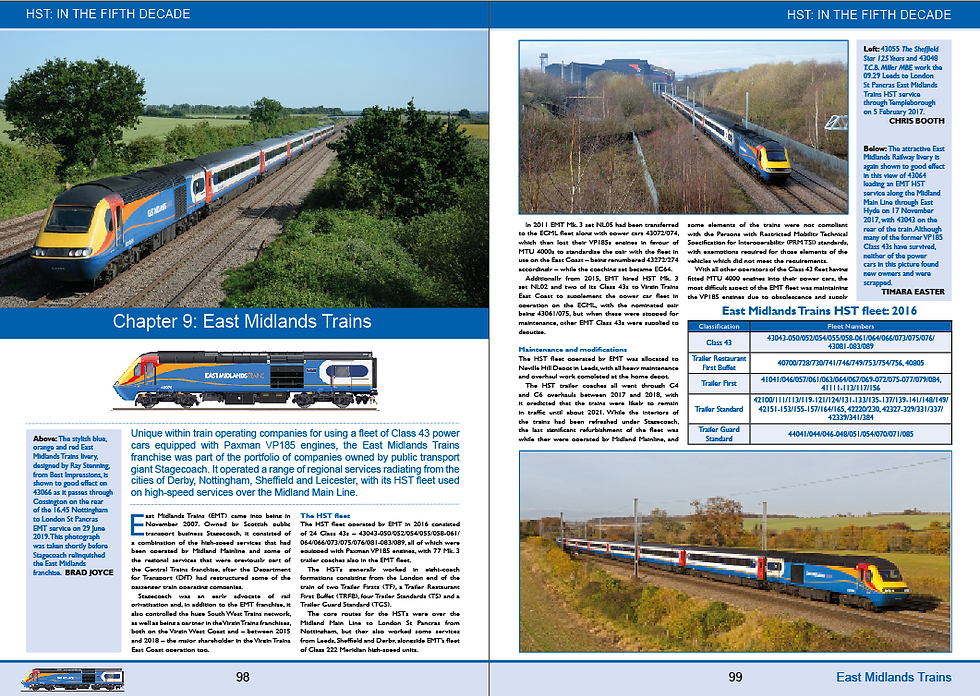
Abellio-backed East Midlands Railway took over from the Stagecoach-owned East Midlands Railway in August 2019 and inherited its fleet of VP185 powered Class 43s, but as mentioned above these were soon replaced with HST sets that had displaced frpm LNER services, with the coaching stock being more compliant with the requirements of the Disability Discrimiation Act. This was only to be a short stay of execution, as HSTs on EMR were withdrawn in May 2021.
Next to go was the CrossCountry HST fleet, which operated long-distance services between Plymouth and Edinburgh alongside the operators fleet of Class 220 and 221s. The small fleet of 12 Class 43s and five rakes of Mk. 3 coaches were removed from traffic in September 2023.
GWRs fleet of regional Castle Class HSTs - introduced into traffic in 2018 on the corridor between Cardiff and Penzance - were withdrawn in December 2025, having been progressively stood down from service over the previous three years.
But the HST story is far from over. Network Rail's NMT continues to monitor track conditions on high speed routes and Colas now has a fleet of 10 Class 43s for working Network Rail test and infrastructure trains. Locomotive Services Group has also created a tribute to the long-scrapped Midland Pullman train using a fleet of ex-EMR Class 43s and GWR trailer coaches, which has proved an incredibly popular for the Crewe-based charter operator. RailAdventure also runs a small fleet of Class 43s on stock moves and a variety of passenger and freight workings, while Romic Group has created a UK HST hire fleet with power cars 43094 and 43122 and a rake of Mk. 3 trailer coaches previously operated by CrossCountry and GWR.
Some HSTs have also been exported for further use abroad, with ex-UK HST vehicles now in operation in both Mexico and Nigeria, with other possible destinations also identified for a large amount of stock currently in store in the UK.
HSTs are now also well represented in preservation with numerous Class 43s and Mk. 3 trailer coaches secured in the heritage sector, both as operational vehicles and static exhibits. There are three dedicated HST preservation groups - 125 Group, 125 Heritage and 125 Preservation - and these operate their HSTs from their bases on the East Lancashire Railway, Colne Valley Railway, and Nene Valley Railway respectively. The 125 Group also maintains its HST vehicles to main line standards and regularly operates tours across the national rail network. Profits generated from the sale of this book will be split between the three HST preservation groups to help them with their valuable work in keeping these vehicles running for future generations.
READ THE FULL STORY OF THE LAST TEN YEARS




bottom of page